
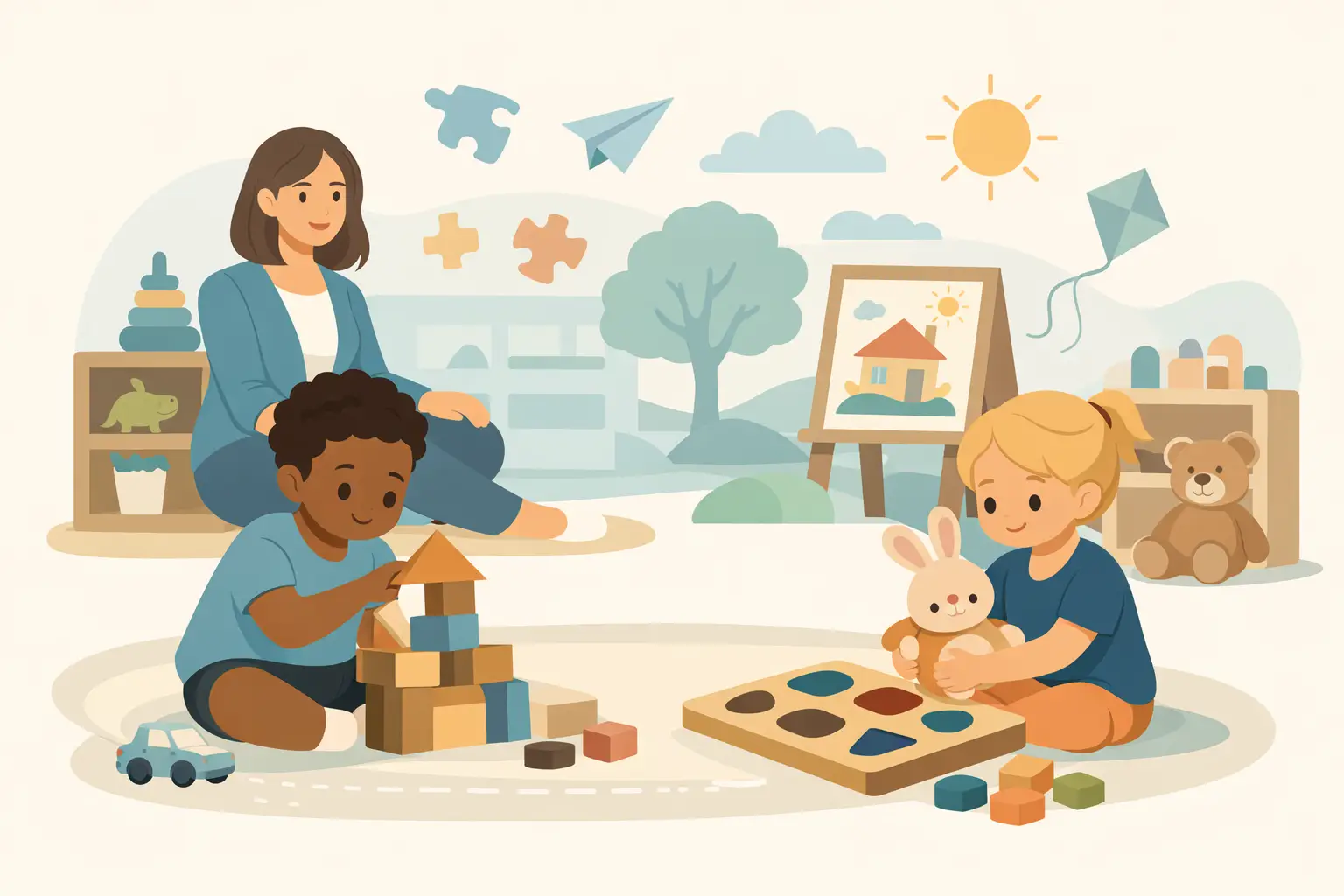
A child kneeling on the floor with blocks may not look like they are working toward literacy, math, or social skills. To an experienced early childhood educator, though, that moment can hold all three. That is the heart of a play based curriculum in early childhood education – children learn best when they are actively engaged, emotionally secure, and free to explore with purpose.
For families, this approach often brings relief. Young children do not need a school-like environment packed with worksheets to be ready for kindergarten. They need responsive adults, thoughtful routines, language-rich experiences, and space to test ideas. For home-based educators, play-based learning offers a practical, developmentally appropriate way to build meaningful learning into everyday care.
What a play based curriculum in early childhood education really means
A play based curriculum in early childhood education is not unstructured chaos, and it is not simply letting children entertain themselves. It is a planned approach where educators create environments, routines, and experiences that support development through play.
In a strong play-based setting, children make choices, investigate materials, solve problems, and practice social skills in real time. The educator watches closely, asks questions, introduces new vocabulary, and extends learning without taking over. A child pouring water between cups may be exploring volume, coordination, patience, and cause and effect. A group pretending to run a grocery store may be building language, turn-taking, early math, and self-regulation all at once.
The difference lies in intention. Play is the vehicle, but learning is still the destination.
Why play matters so much in the early years
Early childhood is a period of rapid brain development. Young children learn through movement, repetition, relationships, and sensory experience. They need to touch, sort, stack, carry, pretend, and talk through what they are doing. Play naturally supports all of that.
When children are emotionally invested in an activity, they are more likely to stay engaged and remember what they have learned. That matters because early learning is not only about academic exposure. It is also about developing the foundation for future learning – curiosity, persistence, communication, and confidence.
This is one reason many families are drawn to licensed family day homes. A smaller, home-like environment can make it easier for children to feel safe enough to explore. When children feel secure, they tend to participate more fully, take manageable risks, and build stronger relationships with caregivers and peers.
What children learn through play
Play-based learning supports the whole child. That phrase can sound broad, but in practice it is very concrete.
Language grows when children describe what they are building, negotiate roles in pretend play, listen to stories, or sing songs with repetition. Early math develops when they compare sizes, count snack items, match shapes, or notice patterns in blocks and beads. Fine motor skills strengthen through puzzles, drawing, scooping, and threading. Gross motor development grows through climbing, dancing, balancing, and outdoor play.
Just as important, children build social and emotional skills through daily interactions. They learn to wait, express frustration, ask for help, recover from disappointment, and cooperate with others. These are not extras. They are central to school readiness and long-term success.
The educator’s role in play-based learning
One common misunderstanding is that play-based learning asks less of the adult. In reality, it asks for careful observation, planning, and responsiveness.
An effective educator pays attention to what each child is interested in and where support is needed. If a child keeps lining up toy animals, the educator might introduce sorting trays, books about habitats, or language such as bigger, smaller, same, and different. If a child struggles to join group play, the educator may guide short partner activities that build comfort and confidence.
This is especially valuable in a licensed family day home. Because group sizes are smaller, educators can notice patterns more quickly and respond in ways that feel personal. They can adapt the environment, adjust routines, and create learning invitations that reflect the children in their care.
That said, play-based learning does not mean every day looks the same or every child follows the same path. Some children need more structure. Others need more sensory input, more movement, or more quiet time before they can engage. A thoughtful educator knows when to step in, when to step back, and when to change course.
How play based curriculum works in a home child care setting
In a home setting, learning often happens through familiar routines and real-life experiences. That is part of what makes this approach so effective. Children can help set the table, water plants, sort toys, zip their coats, or talk about the weather before going outside. These everyday moments support independence, language, problem-solving, and motor development.
The environment also matters. Children do not need expensive equipment to learn well. They need open-ended materials that invite creativity and thinking. Blocks, scarves, art supplies, sensory bins, pretend kitchen items, books, dolls, natural materials, and outdoor tools can all support rich learning when used intentionally.
Routine gives this freedom structure. A predictable day helps children feel secure, while flexible play opportunities let them explore within that framework. Morning arrival, meals, rest, outdoor time, story time, and free play can all become meaningful parts of the curriculum.
For families, this can feel like the best of both worlds – a home away from home with real educational value.
What parents should look for
If you are a parent exploring child care, it helps to look beyond whether a program says it is play-based. Ask what that looks like during the day. How does the caregiver support language? How are conflicts handled? What kinds of materials are available? How much time do children spend outdoors? How are routines used to teach independence and social skills?
It is also reasonable to ask how the program balances nurturing care with learning goals. A good play-based environment should feel warm and responsive, but also purposeful. You want to see children engaged, not just occupied.
Licensing and oversight matter here too. In a regulated setting, families have the added reassurance that health, safety, and operational standards are being monitored. That structure supports quality and consistency, which is especially important for younger children.
What prospective providers should understand
For educators considering family day home care, play-based learning is both rewarding and demanding. It aligns well with home-based care because it allows learning to happen naturally throughout the day. It also requires planning, observation, and a clear understanding of child development.
Some providers worry that parents will expect visible academic work. That concern is understandable. Many families were raised to associate learning with paper-based tasks. Part of the provider’s role is helping families see the learning that is already happening through play. Simple communication can help – sharing what children explored, what skills were practiced, and how activities connect to development.
There are also practical considerations. Materials need to be safe, varied, and accessible. The space needs to support both active play and quiet moments. Mixed-age groups, which are common in family day homes, can be a strength, but they also require thoughtful planning so infants, toddlers, and preschoolers all have appropriate experiences.
This is where agency support makes a real difference. Providers benefit from guidance on standards, safety, setup, and ongoing professional development. Rightchoice Family Day Homes Agency, for example, supports educators in building regulated, nurturing environments where play-based learning can thrive alongside strong compliance practices.
The trade-offs and why balance matters
Play-based learning is highly effective, but it is not a shortcut. It can take time for adults to see progress because the results do not always show up as finished products. A child may spend a week dumping and filling containers before moving into more complex problem-solving. That repetition is part of learning, not a sign that nothing is happening.
It also depends on quality. Play alone is not enough if the environment is poorly planned or the caregiver is not engaged. Children benefit most when play is supported by consistent routines, responsive relationships, and intentional teaching.
Some direct instruction still has a place. Group songs, story reading, modeling how to use materials, or helping children learn a new self-help skill are all valuable. The goal is not to remove teaching. It is to teach in ways that match how young children actually learn.
Why this approach builds lasting confidence
Children who learn through play are not just collecting facts. They are practicing how to think, communicate, and keep going when something feels hard. They learn that their ideas matter. They learn that mistakes can lead to new attempts. They begin to trust themselves.
That confidence carries forward into school and beyond. A child who can ask questions, join a group, manage frustration, and stay curious has a strong foundation for future learning.
For families and educators alike, that is the real value of play-based curriculum. It respects childhood while still taking learning seriously. And when children are given safe, caring spaces to explore with guidance, the growth that follows is often deeper than it first appears.
The best early learning settings do not rush children past childhood. They protect it, support it, and use it well.